
I had a client of mine ask me last week what she can do to increase the amount of pushups she can do. She's at a plateau right now that she can't get past.
First, in order to get better at pushups you have to do....pushups...
Second, progression is the key. The closer that your body gets to the ground, the more difficult the pushup becomes.
So start out conservatively. Do wall pushups to begin. If you can do 50 of them, then you know you're past that level.
Then move on to an incline pushup. Find something like the back of a chair and see if you can do 50 pushups in that position. If you can, then find another incline that makes you go a little closer to the ground, like the seat of a chair and try to pump out 50 (I'm not suggesting that you try to do 50 wall, 50 incline on the back of a chair, and 50 incline on the seat of the chair all within the same session, you might want to space all of those out with some time to give your muscles time to recover).
Continue decreasing the incline until you're on the floor. When you reach the floor, start by doing pushups on your knees. When you're able to do 50 of those, then move on to regular pushups.
To mix it up, try doing pushups where you do holds at intermittent points of the lowering portion of the movement. You can do these at the incline levels, on your knees and in the normal pushup position.
To do this, start at the top of the pushup position and come down one third of the way down and hold it there for a count of 3. Then lower yourself another third of the way down and count to 3 again, then lower yourself to the lowest position (meaning, if you're doing this as a regular pushup, you're at a full range of motion with your nose is only a couple of inches from the ground), and count to three again.
Continue doing this until you have done 10-15 intermittent hold pushups.
As time goes on using both of these styles, you should see an increase in the number of pushups that you are able to do.
www.leanbodyfitness.com
Facebook
Tuesday, June 2, 2009


Friday, May 22, 2009
Portion Size Comparison
We always hear about portion sizes and how if at first we just cut back on the amount that we eat rather than what we eat, it would go along way in reducing our waistlines.
But, what hasn't been discussed or shown is how the portion sizes that are given to us at restaurants etc. have slowly increased over the years.
This article gives you the evidence of how much these portion sizes have increase over the last couple of decades.
There's really not much more to say after that. The proof is in the pictures.
OUT NEXT WEEK
I'm out of town next week so no blog entries. Have a good Memorial Day weekend and I'll be back in a week.
www.leanbodyfitness.com
Facebook
But, what hasn't been discussed or shown is how the portion sizes that are given to us at restaurants etc. have slowly increased over the years.
This article gives you the evidence of how much these portion sizes have increase over the last couple of decades.
There's really not much more to say after that. The proof is in the pictures.
OUT NEXT WEEK
I'm out of town next week so no blog entries. Have a good Memorial Day weekend and I'll be back in a week.
www.leanbodyfitness.com
Thursday, May 21, 2009
Bodybuilding Image Appeal
I wrote earlier this week here about female body image and how I didn't agree that there was as much pressure on women to hold a certain body image like there has been in the past and that the incredibly skinny look of some models really isn't all that appealing to men.
This article came up that made we wonder about the opinion of women and how they viewed the abnormally muscular men that are in the bodybuilding world. Are they appealing, or not so much?
First, some things from the article. There was a bodybuilding contest among Belgian bodybuilders being held in the Netherlands and at the last minute some folks from the Anti-Doping organization showed up and the bodybuilders scattered like rats and it essentially canceled the contest.
This was pretty staggering (yet really not that shocking):
And really, you don't get to that kind of size without the help of steroids. It's just not going to happen.
But it got me thinking about the images of bodybuilders today and bodybuilders of years ago. Here's a pic of Dennis Tinerino who was big on the bodybuilding front in the 1960s:

Now look at this...thing from our current era:

Which looks is more appealing and attractive?
I would even venture that a normal guy that is wanting to put on muscle and have the lean look would view the first picture as being a more desirable goal.
But the second image just looks freaky and it looks outright unhealthy.
And that's another solid point: Physical appearance on the extremes just do not look healthy.
Ladies, correct me if I'm wrong though in my assumption that the big, skies the limit look of a freaky bodybuilder look is what you're after because I'm just not seeing where you'd find that appealing.
www.leanbodyfitness.com
Facebook
This article came up that made we wonder about the opinion of women and how they viewed the abnormally muscular men that are in the bodybuilding world. Are they appealing, or not so much?
First, some things from the article. There was a bodybuilding contest among Belgian bodybuilders being held in the Netherlands and at the last minute some folks from the Anti-Doping organization showed up and the bodybuilders scattered like rats and it essentially canceled the contest.
This was pretty staggering (yet really not that shocking):
Last year, 22 of 29 tests were positive, either for steroids or for refusing testing, a failure rate of a staggering 75 percent.
And really, you don't get to that kind of size without the help of steroids. It's just not going to happen.
But it got me thinking about the images of bodybuilders today and bodybuilders of years ago. Here's a pic of Dennis Tinerino who was big on the bodybuilding front in the 1960s:
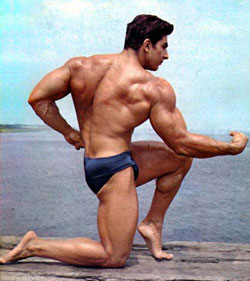
Now look at this...thing from our current era:

Which looks is more appealing and attractive?
I would even venture that a normal guy that is wanting to put on muscle and have the lean look would view the first picture as being a more desirable goal.
But the second image just looks freaky and it looks outright unhealthy.
And that's another solid point: Physical appearance on the extremes just do not look healthy.
Ladies, correct me if I'm wrong though in my assumption that the big, skies the limit look of a freaky bodybuilder look is what you're after because I'm just not seeing where you'd find that appealing.
www.leanbodyfitness.com
Wednesday, May 20, 2009
Intermittent Fasting Update
Back about a month and a half ago, I wrote a review here of a book called Eat Stop Eat that I read and an eating regiment that I followed for 4 weeks that involved fasting for 24 hours, twice a week. During that four weeks, I lost 8.5 pounds.
I took a week off from the fasting after that the last week that I fasted and ended up losing another half a pound.
A week after that, I went back to fasting twice a week for another 4 weeks. I ended up dropping another 5 pounds.
Then I stopped fasting for two weeks and during that time, I dropped another 2 pounds.
So in 11 weeks, I dropped 16 pounds. Not bad.
I also went and had my bloodwork done after the first 9 weeks to see how that looked.
The last time that I had my bloodwork check I blogged about it here.
This time around here were my results:
Total Cholesterol: 130
HDL Cholesterol (the good stuff): 59
LDL Cholesterol (the bad stuff): 65
Triglycerides: 45
Blood Glucose: 89
Blood Pressure: 108/68
Resting Pulse: 80
Everything within normal range.
So after 9 weeks of fasting, no harmful results on the issue of bloodwork.
It was a great ride trying the intermittent fasting out and I highly recommend it as a way to lose weight safely, and quickly.
I highly recommend that you buy the book here, and after you buy it, the offer is still on the table that if you e-mail me your e-receipt, I'll send you a FREE copy of my diary of what I ate and what my workouts were for the original four weeks that I followed this.
Give it a try. You won't be sorry.
www.leanbodyfitness.com
Facebook
I took a week off from the fasting after that the last week that I fasted and ended up losing another half a pound.
A week after that, I went back to fasting twice a week for another 4 weeks. I ended up dropping another 5 pounds.
Then I stopped fasting for two weeks and during that time, I dropped another 2 pounds.
So in 11 weeks, I dropped 16 pounds. Not bad.
I also went and had my bloodwork done after the first 9 weeks to see how that looked.
The last time that I had my bloodwork check I blogged about it here.
This time around here were my results:
Total Cholesterol: 130
HDL Cholesterol (the good stuff): 59
LDL Cholesterol (the bad stuff): 65
Triglycerides: 45
Blood Glucose: 89
Blood Pressure: 108/68
Resting Pulse: 80
Everything within normal range.
So after 9 weeks of fasting, no harmful results on the issue of bloodwork.
It was a great ride trying the intermittent fasting out and I highly recommend it as a way to lose weight safely, and quickly.
I highly recommend that you buy the book here, and after you buy it, the offer is still on the table that if you e-mail me your e-receipt, I'll send you a FREE copy of my diary of what I ate and what my workouts were for the original four weeks that I followed this.
Give it a try. You won't be sorry.
www.leanbodyfitness.com
Monday, May 18, 2009
Strange Poll Results on Weight
When you look at yourself in a mirror, or sit down to eat a meal, what is it that you really see? If you're active and eat well most of the time, why are you doing that? Is it because you want to lose weight and get in shape and look better, or is it because you want to lead a healthy lifestyle to ward off sickness and other ailments? Or is it a little bit of a combination of both?
I've been meaning to blog on this story for awhile but I had to read it a number of different times because I found it somewhat confusing.
It involves a poll conducted by AP and Ivillage and here are some of the findings:
I've read that paragraph a half dozen times and it still doesn't make sense to me. Half don't like the weight that they are at and a third don't like their physical condition. I guess it depends on how you're defining "physical condition" because it seems to be that if half don't like their weight, that those same people don't like their physical condition.
More from the article:
Okay fine, being overweight but continuing to exercise is going to reduce your risk of heart disease but, it would reduce it even more if the excess weight was taken off (yes, I know that might be easier said then done but, it's doable).
Now here's a quote that really bothered me:
Maybe I'm just not looking at this correctly but, if our culture puts a lot of pressure on women to look a certain way (skinny, model type), then why are two-thirds of women overweight or obese? I remember that was the common theory back 10-20 years ago (and earlier), but does it really hold today, in 2009? Beauty pageants that involved women that were so skinny if they turned sideways you probably wouldn't know they were even there, have lost a lot of popularity over the last decade to the point that they aren't even shown on the major networks anymore.
If anything, I think what people have started to realize (and the article states as much) is that getting to a point where you look like this:

Not only looks better (and even men will tell you as such), but is more healthier than looking like this:

But again, I just don't see how there's that much pressure out there anymore to even look like either of those two pictures due to the fact that two-thirds of us are not even close to being able to see our abs.
www.leanbodyfitness.com
Facebook
I've been meaning to blog on this story for awhile but I had to read it a number of different times because I found it somewhat confusing.
It involves a poll conducted by AP and Ivillage and here are some of the findings:
Half don't like their weight, even 26 percent of those whose body mass index or BMI — a measure of weight for height — is in the normal range. But just a third don't like their physical condition, even though being overweight and sedentary are big risk factors for Type 2 diabetes, heart disease and other ailments.
I've read that paragraph a half dozen times and it still doesn't make sense to me. Half don't like the weight that they are at and a third don't like their physical condition. I guess it depends on how you're defining "physical condition" because it seems to be that if half don't like their weight, that those same people don't like their physical condition.
More from the article:
"People can't see the damage that's being done inside their body," says Goldberg. "If you increase your fitness but don't lose as much weight, you still have a lower heart disease risk than someone who is obese and sedentary."
Okay fine, being overweight but continuing to exercise is going to reduce your risk of heart disease but, it would reduce it even more if the excess weight was taken off (yes, I know that might be easier said then done but, it's doable).
Now here's a quote that really bothered me:
"Someone who is fat or even overweight can be healthy if they have a balanced diet and are physically active," Kwan says. "Our culture really does put a lot of pressure on women to look a certain way," taking precedence over health measures.
Maybe I'm just not looking at this correctly but, if our culture puts a lot of pressure on women to look a certain way (skinny, model type), then why are two-thirds of women overweight or obese? I remember that was the common theory back 10-20 years ago (and earlier), but does it really hold today, in 2009? Beauty pageants that involved women that were so skinny if they turned sideways you probably wouldn't know they were even there, have lost a lot of popularity over the last decade to the point that they aren't even shown on the major networks anymore.
If anything, I think what people have started to realize (and the article states as much) is that getting to a point where you look like this:

Not only looks better (and even men will tell you as such), but is more healthier than looking like this:

But again, I just don't see how there's that much pressure out there anymore to even look like either of those two pictures due to the fact that two-thirds of us are not even close to being able to see our abs.
www.leanbodyfitness.com
Friday, May 15, 2009
Friday Workout
I took my dog to the vet the other day for her "day at the spa" and while I was waiting, I went to a park to get a workout in. Here's what I did.
I jogged around this field one time just as a little warm up. Then I did some sprints. First I would sprint just maybe 5 yards. Then walk back. Then sprint again adding another five yards onto what I sprinted before. Walked back again. Kept doing this until I was sprinting about 30 yards or so.
Then it was time to start the workout.
I got down and did a bear crawl for about 20 feet. Then I stood up and did one Pushup-Burpee Combination (meaning, I dropped down to the lower part of the burpee move, completed one pushup, then pulled my legs into my chest and jump straight into the air). Immediately after completing the jump part of the burpee, I sprinted the rest of the way to where I had finished on my last sprint in my warm up.
I then walked back to the starting point, waiting 30 seconds, and did the bear crawl again for 20 feet, and then did the Pushup-Burpee Combination twice (meaning, i dropped down, did one pushup, pulled the legs in and did a vertical jump, dropped back down into a pushup position and did another pushup, pulled the legs in and did a vertical jump), and finished with the sprint again. Walked back to the starting point, and rested 30 seconds.
I kept doing this over and over again and adding another Pushup-Burpee combination each time. My goal was to do 10 of them but, after the 8th one, I was pretty spent and decided to call it a day. Workout took about 25 minutes and it was great.
Remember efficiency in exercise. You don't need to spend hours and hours working out. A quick intense 20-30 minute workout is just as good for overall health, and even better for fat loss.
Have a good weekend.
www.leanbodyfitness.com
Facebook
I jogged around this field one time just as a little warm up. Then I did some sprints. First I would sprint just maybe 5 yards. Then walk back. Then sprint again adding another five yards onto what I sprinted before. Walked back again. Kept doing this until I was sprinting about 30 yards or so.
Then it was time to start the workout.
I got down and did a bear crawl for about 20 feet. Then I stood up and did one Pushup-Burpee Combination (meaning, I dropped down to the lower part of the burpee move, completed one pushup, then pulled my legs into my chest and jump straight into the air). Immediately after completing the jump part of the burpee, I sprinted the rest of the way to where I had finished on my last sprint in my warm up.
I then walked back to the starting point, waiting 30 seconds, and did the bear crawl again for 20 feet, and then did the Pushup-Burpee Combination twice (meaning, i dropped down, did one pushup, pulled the legs in and did a vertical jump, dropped back down into a pushup position and did another pushup, pulled the legs in and did a vertical jump), and finished with the sprint again. Walked back to the starting point, and rested 30 seconds.
I kept doing this over and over again and adding another Pushup-Burpee combination each time. My goal was to do 10 of them but, after the 8th one, I was pretty spent and decided to call it a day. Workout took about 25 minutes and it was great.
Remember efficiency in exercise. You don't need to spend hours and hours working out. A quick intense 20-30 minute workout is just as good for overall health, and even better for fat loss.
Have a good weekend.
www.leanbodyfitness.com
Thursday, May 14, 2009
Taxing Soda
I've stated in the past here that I'm not a big fan of regular soda.
But how much of an affect would there be on sales of soda if there were a tax specifically on high calorie drinks like regular soda, energy drinks, etc.?
This article talks about how that is being entertained in the conversations among lawmakers as they try to take on the healthcare issues in the United States:
How much would the tax be?:
Three cents? I think you can look at this in two different ways. It's three cent more for every 12 ounces so a normal 20-ouncer would cost an extra 5 cents. I guess if the argument is that it's going to generate $24 billion over 4 years towards changes to a health care system that is in need of changes, then it seems like a small price to pay.
But at the same time, let's not go to the extremely laughable argument like this:
I highly doubt that anyone is going to drop their 2 a day Mountain Dew addiction because the price of each one goes up 5 cents. So please, let's not try with a straight face that this is being proposed to get people healthier, it's being proposed to raise revenue for health care changes.
Want to discourage people from drinking soda with a tax? Make it a two dollar a bottle tax and then you might get some people that'll give up the habit if it's going to cost them $4 for a 20-ouncer.
It seems this approach might be better:
Get the soda machines out of the schools, stop the daily menu of high calorie pizza and burritos in the school cafeterias and create required classes in school that focus on health and nutrition. That's going to go a much longer way in truly fighting against the obesity epidemic than three cents.
www.leanbodyfitness.com
Facebook
But how much of an affect would there be on sales of soda if there were a tax specifically on high calorie drinks like regular soda, energy drinks, etc.?
This article talks about how that is being entertained in the conversations among lawmakers as they try to take on the healthcare issues in the United States:
The Center for Science in the Public Interest, a Washington-based watchdog group that pressures food companies to make healthier products, plans to propose a federal excise tax on soda, certain fruit drinks, energy drinks, sports drinks and ready-to-drink teas. It would not include most diet beverages. Excise taxes are levied on goods and manufacturers typically pass them on to consumers.
How much would the tax be?:
The Congressional Budget Office, which is providing lawmakers with cost estimates for each potential change in the health overhaul, included the option in a broad report on health-system financing in December. The office estimated that adding a tax of three cents per 12-ounce serving to these types of sweetened drinks would generate $24 billion over the next four years.
Three cents? I think you can look at this in two different ways. It's three cent more for every 12 ounces so a normal 20-ouncer would cost an extra 5 cents. I guess if the argument is that it's going to generate $24 billion over 4 years towards changes to a health care system that is in need of changes, then it seems like a small price to pay.
But at the same time, let's not go to the extremely laughable argument like this:
Proponents of the tax cite research showing that consuming sugar-sweetened drinks can lead to obesity, diabetes and other ailments. They say the tax would lower consumption, reduce health problems and save medical costs.
I highly doubt that anyone is going to drop their 2 a day Mountain Dew addiction because the price of each one goes up 5 cents. So please, let's not try with a straight face that this is being proposed to get people healthier, it's being proposed to raise revenue for health care changes.
Want to discourage people from drinking soda with a tax? Make it a two dollar a bottle tax and then you might get some people that'll give up the habit if it's going to cost them $4 for a 20-ouncer.
It seems this approach might be better:
"Taxes are not going to teach our children how to have a healthy lifestyle," said Susan Neely, president of the American Beverage Association. Instead, the association says it's backing programs that limit sugary beverage consumption in schools.
Get the soda machines out of the schools, stop the daily menu of high calorie pizza and burritos in the school cafeterias and create required classes in school that focus on health and nutrition. That's going to go a much longer way in truly fighting against the obesity epidemic than three cents.
www.leanbodyfitness.com
Subscribe to:
Posts (Atom)

